


Is Your Business Prepared for a Disaster? Shocking Stats Inside
Updated: Jun 11, 2025
Disasters don’t wait for a convenient time. Businesses that fail to prepare often suffer devastating consequences, whether from a cyberattack, supply chain disruption, or natural disaster. Unfortunately, too many organizations assume they are ready—only to find out the hard way that they are not.
Let us explore some eye-opening statistics on business disaster preparedness, companies’ most common mistakes, and how to protect your business from unexpected disruptions.
Shocking Statistics on Business Disaster Preparedness
60% of small businesses fail within six months of a cyberattack (National Cyber Security Alliance, 2021).
93% of businesses without disaster recovery planning close within a year after a major data loss (Ponemon Institute, 2022).
Only 54% of businesses have a documented disaster recovery plan (Continuity Central, 2023).
75% of companies do not test their disaster recovery plans regularly (IBM, 2022).
43% of businesses that experience a disaster never reopen (FEMA, 2021).
These numbers highlight a significant problem: Many businesses think they are prepared, but when disaster strikes, they realize their plans are outdated, incomplete, or nonexistent.

Common Mistakes Businesses Make in Disaster Planning
1. No Documented Disaster Recovery Plan
Many business owners assume they will “figure it out” when the time comes. However, a lack of clear guidelines in a high-stress crisis leads to chaos, costly delays, and even permanent business closure.
✅ Solution: Develop a documented Business Continuity and Disaster Recovery Plan (BCDRP) that outlines step-by-step procedures for different types of disasters.
2. Infrequent or No Testing
A plan is only as strong as its execution. Businesses that do not test their recovery procedures often find out that their plan is ineffective too late.
✅ Solution: Schedule routine disaster simulations and tabletop exercises to ensure your team knows what to do in a crisis.
3. Overlooking Cybersecurity Threats
Cybercrime is a growing threat, yet many businesses fail to prioritize cybersecurity in their disaster planning. Ransomware, phishing attacks, and data breaches can instantly shut down operations.
✅ Solution: Implement secure data backup solutions, employee training programs, and incident response protocols to safeguard digital assets.
4. No Communication Plan
Misinformation and panic can cause significant disruptions during a crisis. Businesses without a communication strategy struggle to relay critical information to employees, customers, and stakeholders.
✅ Solution: Establish a communication protocol that includes internal and external messaging templates, emergency contacts, and backup communication channels.
5. Lack of Supply Chain Contingency Planning
Disruptions in the supply chain can halt business operations, leaving companies without products, materials, or essential services.
✅ Solution: Identify alternative suppliers and create contingency plans to maintain operations during supply chain disruptions.
Prepare for These Business Pain Points
Beyond fixing common mistakes, it is essential to plan for specific pain points that businesses face during disasters:
Financial Strain: How will you cover expenses if operations pause?
Regulatory Compliance: Are you prepared for potential legal and regulatory implications?
Customer Trust: Do you have a strategy to maintain customer relationships after a disruption?
Employee Safety & Productivity: How will you ensure employees remain safe and operational?
Take Action Before Disaster Strikes
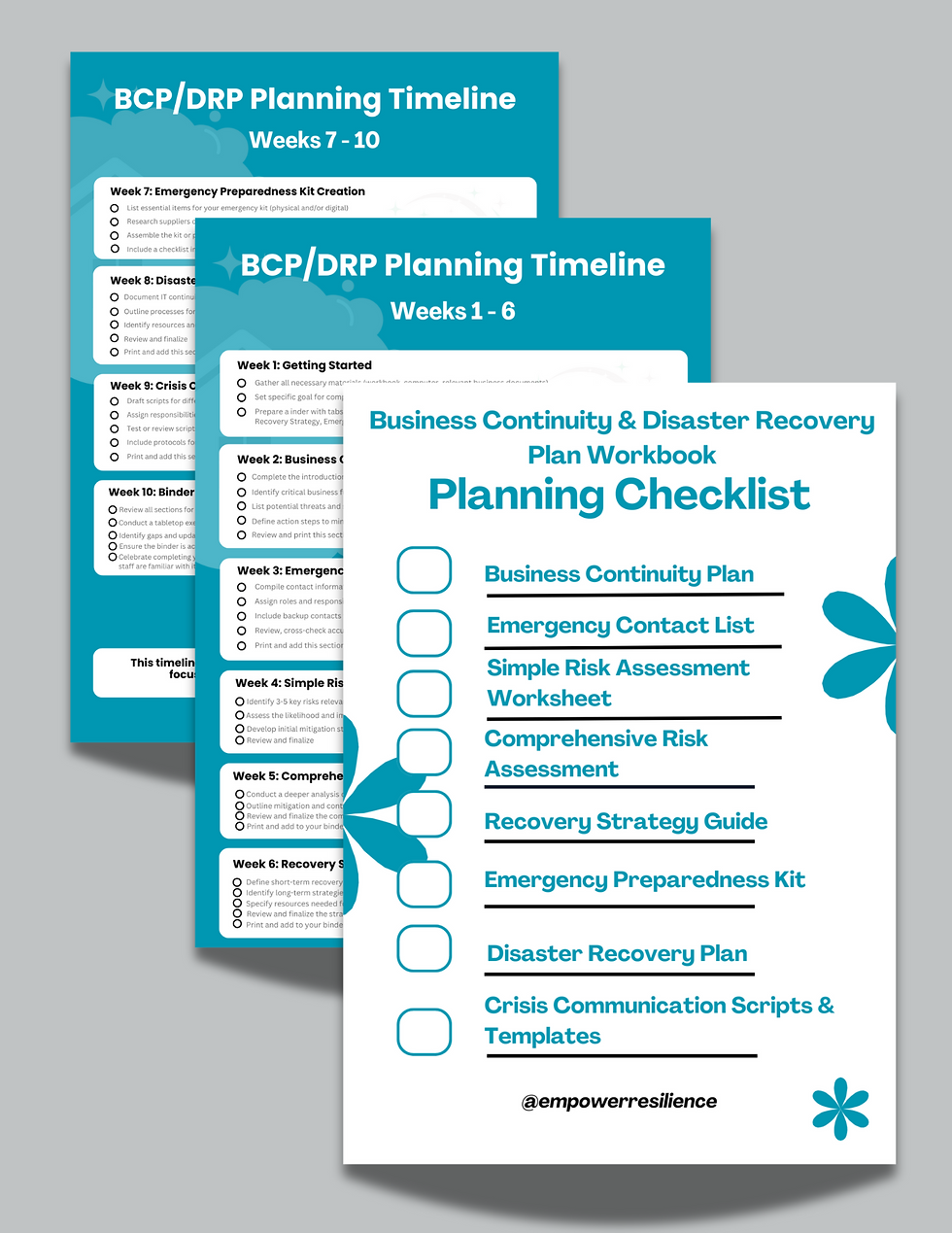
Do not become another statistic. The Business Continuity and Disaster Recovery Plan Workbook provides a step-by-step guide to building a solid disaster recovery plan that protects your business from unforeseen events.
Easy-to-follow templates and checklists
Proven strategies for risk assessment, communication, and recovery
Best practices from industry leaders
Get Your Copy of the Business Continuity and Disaster Recovery Plan Workbook Today!
When it comes to business survival, the unexpected is not a matter of if—it is a matter of when.
Blog References
Federal Emergency Management Agency (FEMA). (2021). Disaster recovery and business continuity planning. https://www.fema.gov
IBM. (2022). Annual cost of a data breach report. https://www.ibm.com/security/data-breach
National Cyber Security Alliance. (2021). Small business cybersecurity statistics. https://www.staysafeonline.org
Ponemon Institute. (2022). The state of disaster recovery in businesses. https://www.ponemon.org
Continuity Central. (2023). Business disaster recovery planning trends. https://www.continuitycentral.com




Comments